
How Modern Farms Produce Millions of Eggs and Chicken Meat
Today, we’re taking you on a captivating journey into the heart of modern poultry farming. Join us as we uncover the fascinating life of a chicken, from the very beginning in breeder operations to the final packaging stage. All of this is made possible under the expert care of Bell & Evans, the oldest branded chicken company in America. Ready? Let’s embark on this journey into the world of chickens!
Breeder Operations
We start first in the intriguing world of breeder operations. Aiming to give you an in-depth understanding of this crucial stage in chicken farming.
A breeder operation is a fundamental component in the life cycle of poultry. It serves as the heart of the chicken production process, where meticulous care is taken to nurture and monitor the birds that will eventually produce the next generation of chickens.
One of the key aspects of this operation is the management of male and female chickens. These are the primary contributors to hatching eggs that will later be processed at a hatchery facility. Males and females have distinct dietary needs, and their feeding systems are designed accordingly to ensure their optimal growth and health.
Males are provided feed from a suspended pan feeder, strategically positioned to prevent hens from accessing it. Hens, on the other hand, are fed through chain feeders. Their diet is tailored to support egg production, requiring a higher level of nutrients. Roosters are not fed from the hen feeder due to their size, as they are unable to access the grill. This feeding setup allows for the provision of distinct diets to meet the needs of both male and female chickens.
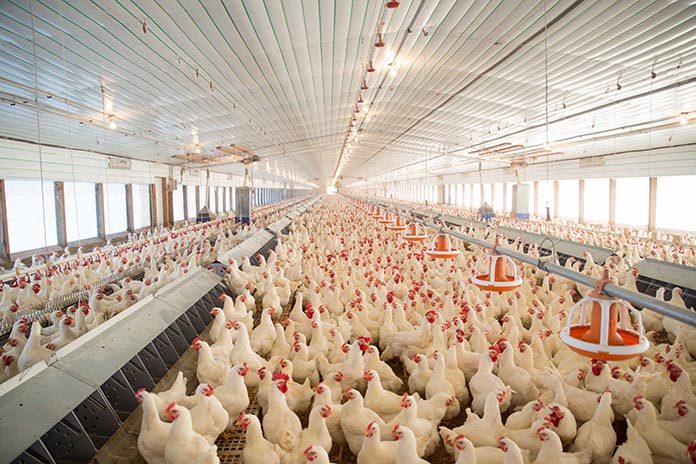
The facility itself plays a crucial role in maintaining an ideal environment for the birds. The chickens freely roam within each house, housed in a standard curtain building designed to optimize their living conditions. This structure allows for an abundance of natural light and cooler temperatures, creating a comfortable environment for the chickens.
Ventilation is a critical aspect, managed through sidewall fans and air inlets. During periods of moderate temperatures, the facility utilizes natural ventilation, with curtains that adjust to maintain the ideal climate. In instances of warmer outdoor conditions, the building seamlessly transitions to a modern, tunnel-ventilated system, ensuring the chickens’ wellbeing is prioritized in varying weather conditions.
Automation is the backbone of breeder operations. From feeding to ventilation and watering, a central controller orchestrates it all. This automated system guarantees that the birds are well-fed, comfortable, and content throughout the process
The facility is equipped with a barn scraper, a vital tool that facilitates the removal of manure from the buildings five times a day. This frequent cleaning not only ensures excellent hygiene but also offers effective control over rodents and flies.
The result is consistently high air quality for the birds throughout the year, thanks to the absence of manure within the buildings. This approach also fosters a neighbor-friendly environment, since the fans don’t release ammonia into the surroundings. Essentially, the system maintains a continuous flow of fresh air in and out of the buildings. Moreover, all the feeding, ventilation, and watering systems operate autonomously through a centralized controller, streamlining the care process for the chickens.
Within these breeder houses, there are approximately 14,000 hens, and collectively, they produce around 12,000 hatching eggs daily. This remarkable production capacity is a testament to the precision and expertise that goes into maintaining the integrity of the chicken farming process.
Once the hens lay their eggs in designated nests, the eggs roll forward onto an egg collection belt. The next step is to ensure the separation of hatching eggs from non-hatching ones. This is a critical stage that requires a meticulous approach, as only the highest-quality hatching eggs are selected.
To assist in this process, automated hatching egg packers have been introduced. These machines work alongside skilled producers to grade the eggs, ensuring that the hatching eggs are packed correctly with their pointed ends down, which is vital for the hatching chicks.
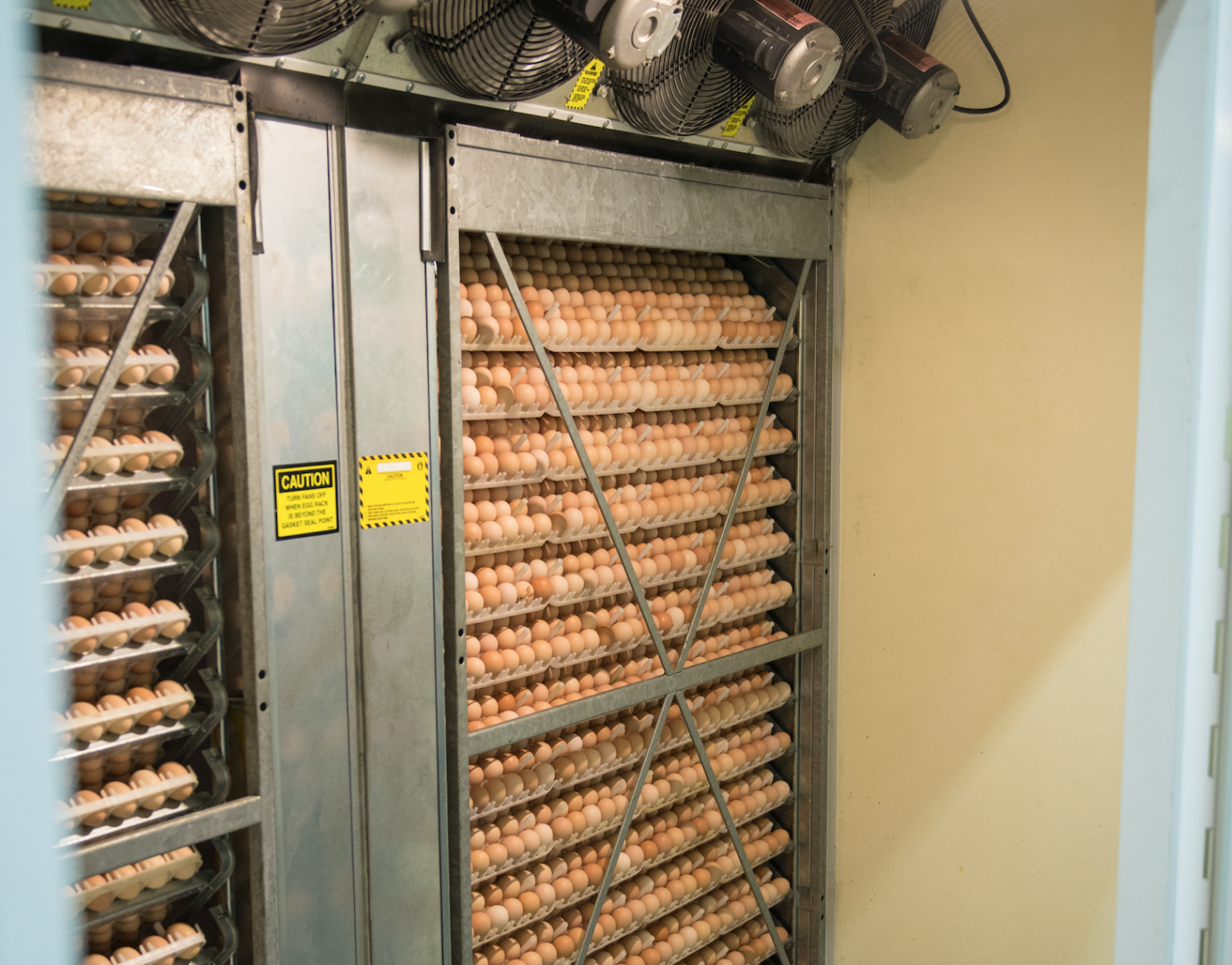
Following the grading process, the hatching eggs are placed into farm racks and gently transported to a cooler where they are stored at a constant 68 degrees. Here, they await their next journey, which is to the hatchery.
Hatchery Facility
Upon arrival at the hatchery, the eggs are carefully unloaded and subjected to a biosecurity procedure, ensuring that they are free from contaminants. This step is crucial, as it lays the foundation for the health and well-being of the developing embryos.
The eggs are then placed in incubation units, where they will spend the next 18 days. Here, they are kept under precise conditions of temperature, humidity, and ventilation, monitored closely to ensure their proper development.
During this incubation period, the eggs are turned regularly, mimicking the natural movements of a brooding hen. This careful handling ensures uniform development and prepares the embryos for the next stage of their journey.
As the 18th day approaches, the eggs are subjected to a process called candling, where they are illuminated to reveal the condition of the embryo inside. Only those eggs with a viable embryo are selected to continue on to the hatching phase.
In the hatching phase, the selected eggs are transferred to a different set of incubators, where they will spend the next three days. Here, the conditions are adjusted to support the hatching process, as the chicks prepare to make their way into the world.
The hatchery is designed to provide a safe and nurturing environment for the chicks as they hatch. The floors are lined with soft material, and the temperature and humidity are carefully controlled to create an ideal atmosphere.
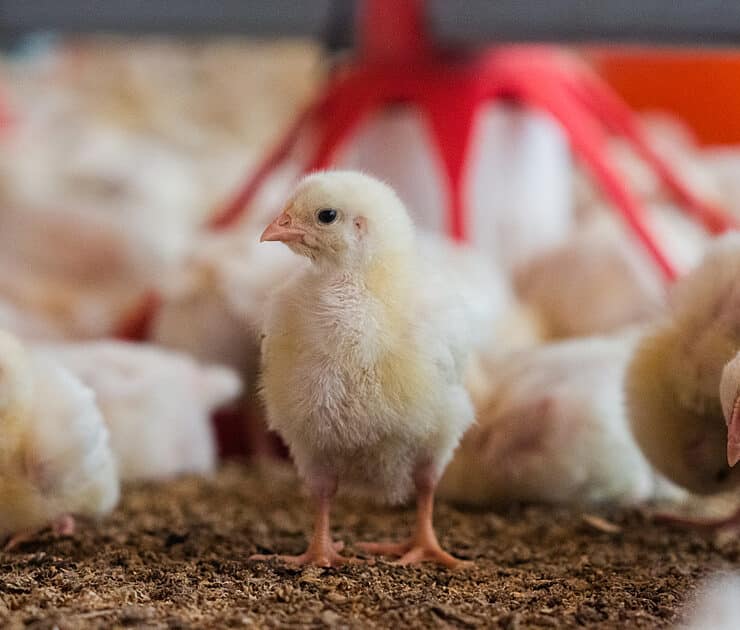
As the chicks hatch, they are gently guided into holding areas, where they are provided with their first food and water. This early nourishment is crucial, as it helps to build their strength for the journey ahead.
Once the chicks are strong enough, they are carefully transported to their new homes on farms, where they will continue their growth and development. Here, they will be cared for by skilled farmers, who ensure they receive the best possible care.
The egg collection and hatching process is a symphony of precision, care, and innovation. It requires a deep understanding of the needs of both the eggs and the chicks, and a commitment to providing the best possible environment for their development.
Broiler Farm
We move now into the next stage, the broiler farm. Take a look at these modern facilities, where everything is designed with the chickens’ needs in mind.
Notice the cleanliness and organization here. Unlike some traditional farms with dirt floors, these facilities feature cement flooring, making it easier to thoroughly clean and prepare for each new flock. This is a crucial step in maintaining a healthy environment and breaking the cycle of bacteria.
The farms are conveniently located less than an hour’s drive from the hatchery, ensuring the chicks have a short and stress-free journey. During transit, they ride in specially designed chick trailers, complete with access to organic feed.
Upon arrival, the houses are kept dimly lit to keep the chicks calm and discourage interaction with equipment until they’re settled. This is a stark contrast to some farms where continuous lighting is used to accelerate growth. Here, the focus is on creating a low-stress environment, with natural daylight and rest periods.
The living conditions are top-notch, with advanced heating and cooling systems maintaining a comfortable temperature year-round. Unlike practices that confine chicks to small areas, here the birds have the freedom to roam and explore. For organic chickens, there’s even access to outdoor space, though many prefer staying indoors.
The feed is another area where this farm stands out. It’s a 100% natural blend of U.S.-grown corn and soybeans, ensuring the chickens get a balanced and nutritious diet. This commitment to quality feed supports both local agriculture and the health of the chickens.
When it’s time to transport the birds, they are moved using a spacious modular drawer system, ensuring their comfort and safety. From living conditions to feed, and even transportation, every aspect of the process is designed to minimize stress and promote well-being.
This closer look at broiler chicken farming highlights the commitment to practices that prioritize the health and comfort of the chickens, ensuring they grow up in the best possible conditions.
Live Receiving
This expansive facility, equivalent to seven football fields, bears witness to a substantial investment of over $360 million. It has been the first facility to secure the green loan in the history of U.S. poultry.
The operations here are divided into two key phases: first processing and second processing. The former encompasses live receiving, harvesting, and chilling of the chickens. The latter is where the chickens and their parts are prepared for packaging and shipment.
It all begins with ‘Live Receiving,’ where the chickens arrive from nearby farms. What sets these chickens apart is their intentionality; they’re raised to a healthy 5.6-pound average live weight, considerably smaller than industry norms. This decision is rooted in animal welfare principles and product quality considerations.
The live receiving process has undergone substantial upgrades, including the use of state-of-the-art, lightweight trailers designed for improved fuel efficiency. These trailers are equipped with winter and summer side curtains, ensuring the birds are shielded from the elements.
Innovative, larger trays have been introduced to provide ample headroom and superior ventilation compared to traditional crates. The purpose of these trays is to integrate with the fully automated unloading system, eliminating human handling while the chickens are conscious.
This facility is home to North America’s first fully automated unloading system. Blue lighting within this area creates a calming environment for the chickens, enhancing their stress-free transition into the facility.
This controlled temperature environment ensures both chicken and team member comfort. White lights are activated after processing for enhanced visibility during cleaning.
The facility showcases impressive automation, including a sophisticated unstacking machine that carefully transports modules of chickens inside. A standout feature is the Slow Induction Anesthesia (SIA) process, a groundbreaking innovation unique to this facility, which guarantees a compassionate and stress-free approach to rendering the chickens unconscious. This method reflects the facility’s commitment to humane practices and animal welfare.
A breakthrough in this process is the introduction of oxygen-infused CO2, providing even more precise control and gentleness. Through windows, the SIA process can be witnessed, where birds do remain calm.

Harvest Process
The journey then moves into ‘The Harvest Process,’ where the chickens are fully unconscious. This not only guarantees team members will never have to shackle a conscious bird but also enables a brightly lit working environment. Afterward, every tray is meticulously cleansed using hot water and organic-approved disinfectant.
Moving along in our journey through this state-of-the-art facility, we arrive at a crucial stage in poultry processing: the feather pickers. This machinery plays a vital role in ensuring that the birds are prepared for the next steps with precision and care.
In this area, the chickens, now fully unconscious, enter a system of feather pickers designed to be both efficient and gentle. Notably, we’ve installed nine feather pickers, nearly double the amount used by other producers. This emphasis on detail guarantees an optimal balance between cleanliness and product integrity, upholding industry standards for quality.
The first set of pickers primarily focuses on removing the body feathers. It’s a process that’s been fine-tuned over the years to ensure every bird is treated with the utmost care. Following this, the second set of pickers comes into play, concentrating on the removal of pin feathers, doing so in a methodical manner to maintain the quality of the skin.
This particular stage in the poultry processing journey holds significant importance; it is at this stage that the birds are meticulously cleaned and checked for any tears, contributing to the high-quality end product. Feathers and other by-products are seamlessly transported to a rendering facility, bypassing the need for transfer bins. This strategic move not only mitigates contamination risks but also enhances the overall safety protocols of the plant.
Electrical stimulation follows to tenderize the meat, and a specialized chicken cinder further refines the process, removing pin feathers and reducing surface bacteria. The stage before evisceration is an important one.

Evisceration Process
As we delve into the evisceration process, it’s vital to understand the meticulous steps involved to ensure product quality and uphold rigorous food safety standards.
Once chickens are fully defeathered they are gently conveyed into the evisceration area.
Cutting-edge camera technology is employed for vision grading, capturing detailed images of each bird, both front and back. This technology detects any exterior defects, ensuring that only top-quality products advance. Birds that do not meet the quality standards are automatically rerouted to sorting stations for further examination.
Following vision grading, the chickens are placed on color-coded hangers, aiding team members in quality checks. Weight data is meticulously recorded before and after evisceration, ensuring consistency.
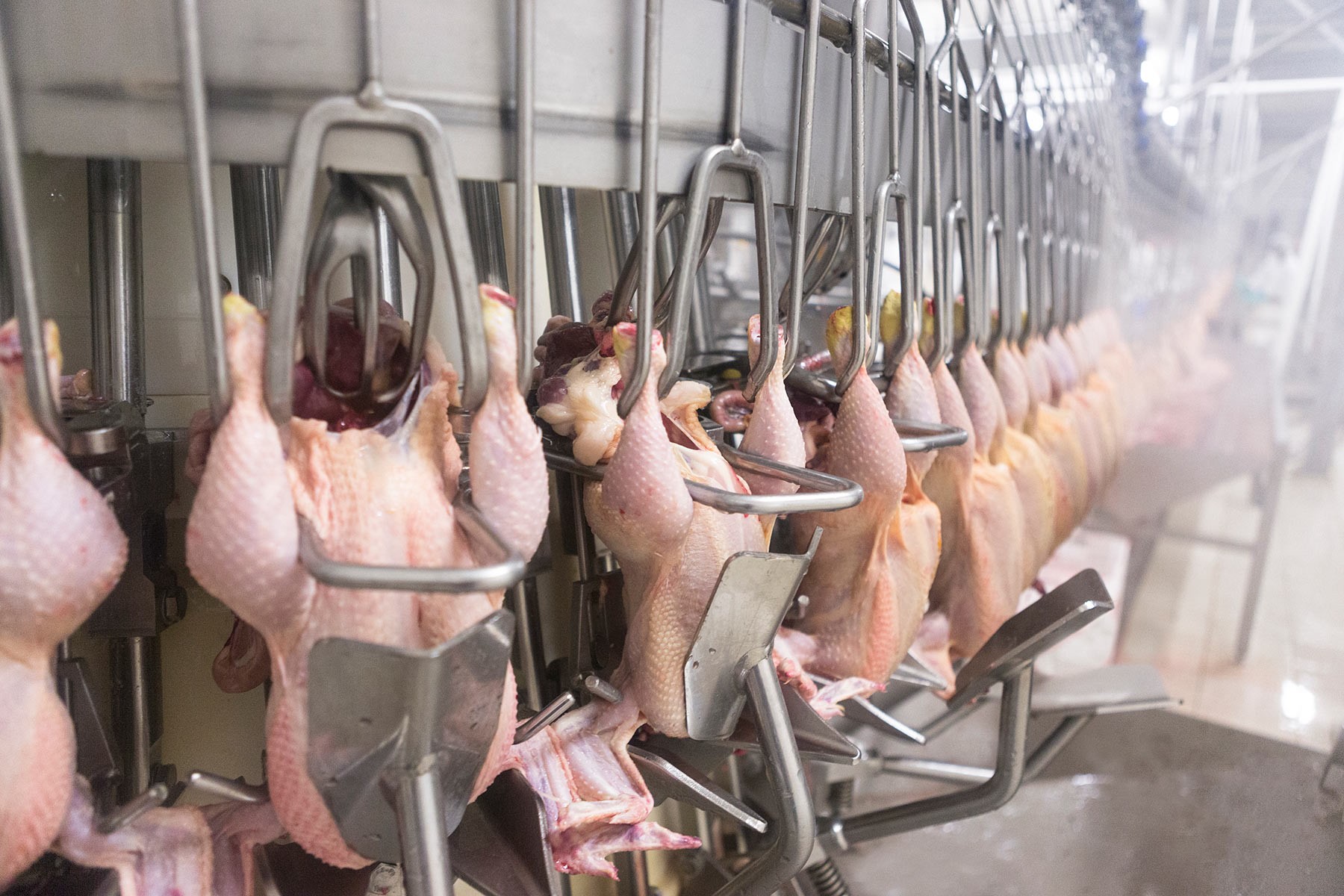
Innards, including the digestive system, are meticulously removed, leaving a clean canvas for further processing and eliminating potential contaminants.
An initial inspection follows the removal of innards, with any detected anomalies promptly addressed, ensuring the maintenance of high-quality standards.
The birds then undergo a rinse with an organic antimicrobial solution, significantly reducing surface bacteria and enhancing food safety, thus extending shelf life.
In a separate facility, giblets, including the liver, gizzards, and hearts, are hand-sorted and evaluated for quality. Premium giblets are then packaged for various culinary uses. Bell and Evans is the only U.S producer with a dedicated giblet processing room.
After these rigorous processes, the chickens are ready for chilling, a critical step for maintaining both product quality and food safety. The Evisceration Process ensures thorough removal of the chicken’s innards, thorough examination, and a commitment to premium quality.
Air Chill Process
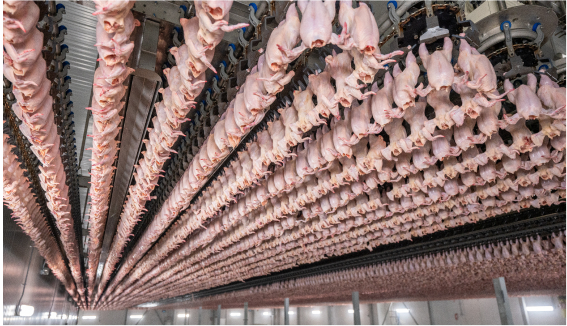
The next pivotal stage in poultry processing is the ‘100% Air Chill Process,’ implemented since 2004 as an innovative alternative to the more common chlorinated water baths.
This method utilizes a flow of cold air to gradually reduce the temperature of the chickens and giblets. The primary goal of this process is to ensure the preservation of the bird’s natural juices, contributing to a more tender and flavorful final product.
The process unfolds in two main phases. Initially, the exterior of the bird is rapidly cooled, helping to lock in its natural juices. Following this, a secondary, slower phase ensures an even and balanced cooling of the entire bird. The end result is a product that stands out for its tenderness and taste.
What differentiates this process further is its approach to food safety and sustainability. By avoiding the use of chlorinated water baths, the air chill process ensures that no chlorinated water is absorbed into the meat, a significant consideration for both taste and health.
As the birds move through almost two miles of track during this process, it becomes evident how such innovative methods contribute to the quality of the final product. Once this phase is complete, the journey transitions to ‘Second Processing,’ where the birds are broken down into various cuts. These encompass whole birds, white meat, dark meat, specialty cuts, and packaging.
Second Processing
The process begins with skilled workers or automated machinery meticulously deboning the carcasses. Precision is key here, as the goal is to preserve the integrity of the meat while ensuring maximum yield. The breasts, wings, thighs, and drumsticks are separated, each destined for a different culinary purpose.
Following deboning, the meat undergoes further processing. For some cuts, this means being trimmed, portioned, or ground, depending on the desired end product. Throughout this stage, quality control is paramount, with workers and machines diligently checking each piece to ensure it meets the industry’s strict standards.
In addition to whole cuts, this stage of processing also gives rise to a variety of other products. Ground meat is blended and seasoned, ready to be transformed into patties or sausages. Off-cuts and trimmings are utilized as well, ensuring minimal waste in the process.
Throughout Second Processing, hygiene and food safety are of the utmost importance. The facilities maintain rigorous cleaning and sanitation protocols, ensuring that every product leaving this stage is safe for consumption.
With the precision of Second Processing complete, the poultry products are now ready to undergo Further Processing, Packaging, and Distribution, the final stages in their journey from farm to table.

Further Processing
In Further Processing, some of the poultry products are transformed into value-added items. This could include marinating, breading, or cooking. Specialty products like nuggets, patties, or sausages are created here, requiring specific machinery and expertise. The goal is to enhance the natural flavors of the poultry while ensuring the products are safe and delicious to eat.
Once the products are prepared, they move on to the packaging stage. Here, they are weighed, labeled, and sealed in packaging that will protect them during transportation and ensure freshness upon arrival at their final destination. The packaging also provides consumers with important information such as nutritional facts, cooking instructions, and expiry dates.
Simultaneously, rigorous quality control procedures are in place to ensure that each product meets the required standards. Samples are taken and tested for a range of factors, including weight, temperature, and potential contaminants.

Distribution Stage
The journey of poultry processing ends in the Distribution stage, where the meticulously packaged products are organized and loaded onto refrigerated trucks. This critical step ensures the integrity of the cold chain, preserving the quality and safety of the products during transportation. The journey of these products extends to various destinations, encompassing supermarkets, restaurants, and a plethora of retail outlets, ultimately making them readily available to consumers.
In wrapping up this extensive exploration of poultry processing, it becomes evident that the journey from farm to table is one marked by precision, dedication, and a steadfast commitment to quality and food safety. The modern chicken farm, central to this journey, operates with cutting-edge technology and sustainable practices, ensuring that the poultry is raised in a humane, stress-free environment.

Conclusion
From the initial breeder operations to the final steps of packaging. It has been a voyage illuminated by innovation, commitment to quality, and an unwavering dedication to upholding the highest standards of animal welfare.
If you have enjoyed this episode, make sure to check the rest of our Agricultural Technology Category, where you will find more articles like this one.